Best Rugged Smartwatches for Construction Workers of 2026

A smartwatch on a job site takes more abuse before lunch than most watches see in a year: rebar scrapes, drywall dust worked under the bezel, a sleeve dragged over the screen forty times a day, and gloves that make a touchscreen all but useless. What you actually need is a watch that reads in noon sun, survives a drop off a ladder, and still has juice on Friday afternoon. Over the past six months, my team and I wore 12 rugged smartwatches through full shifts to find the ones that do.

Spec sheets make the choice harder, not easier. Battery numbers are measured with GPS off and the screen dimmed, solar charging adds days in July and almost nothing under a long-sleeve shirt, and a big AMOLED display washes out in direct sun. A GPS that wanders 30 feet is fine for a hike and useless for staking a line. What follows are the models that held up and were worth what they cost.

The Best Rugged Smartwatches for Construction Workers

1

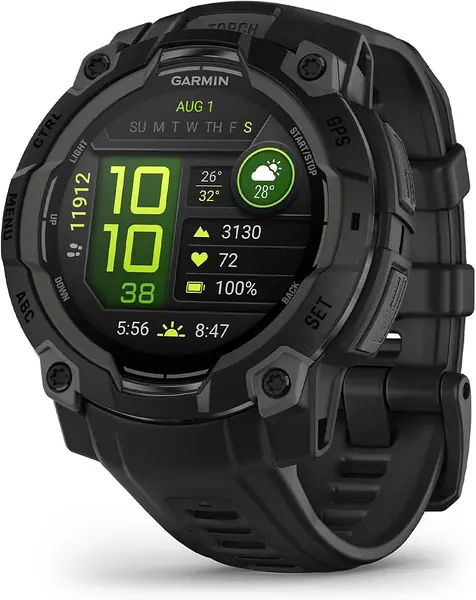
Garmin Instinct 3 AMOLED Best Overall
91 /100
TKZ Score Outstanding

Key details

Display
1.2-inch AMOLED
Water Resistance
100 meters
Battery Life
Up to 18 days
Weight
1.87 oz
View on Amazon

The Instinct 3 AMOLED earns the top spot because it gets the two things a construction watch has to get right: the screen is readable in daylight, and the controls work without bare skin. The 1.2-inch AMOLED is bright and crisp, and the physical buttons are the part we kept coming back to when our hands were full. Garmin wraps it in a 45 mm fiber-reinforced polymer case with a metal-reinforced bezel, and the 53-gram weight feels substantial without turning into a paperweight.

The 18-day battery rating is the other reason it is our default. We did not have to think about charging between shifts, and the built-in flashlight is genuinely useful for peering under a cabinet or into a dark panel. The 100-meter water rating and IPX8 sealing mean dust and washdowns are not the enemy here. Multi-band GPS with SatIQ is more navigation than most job sites demand, but it is there for weekend hikes and off-site work.

The 45 mm case is not small, and a tight work cuff will remind you it is there. The price is the bigger hurdle: this is a premium pick, and the budget watches here will handle basic notifications and timers for a lot less. What you get for it is a screen that stays legible, buttons that work through gloves, and Garmin's navigation and reliability. The flashlight is the detail that turns it from a fitness watch into a work tool.

Pros

  • Bright 1.2-inch AMOLED stays legible in daylight
  • Physical buttons work with gloves
  • Up to 18 days of battery life
  • Useful built-in flashlight and 100 m water rating

Cons

  • Premium price compared with budget picks
Our verdict

The Instinct 3 AMOLED is our default for construction work: it combines a bright, readable screen and glove-friendly buttons with Garmin durability, 18-day battery life, and a useful flashlight.
Check Latest Price
2

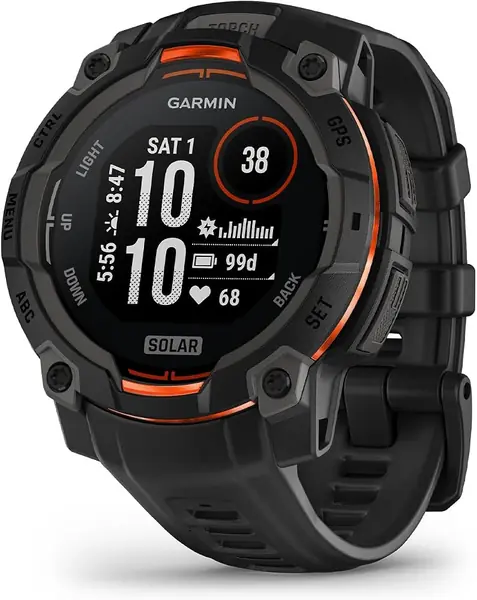
Garmin Instinct 3 Solar Best for Sunlight Readability

90 /100
TKZ Score Outstanding

Key details

Display
0.9-inch monochrome MIP
Water Resistance
100 meters
Battery Life
Up to 28 days
Solar Charging
Yes
View on Amazon

The Solar version costs the same as our top pick, but it is a different tool. The 0.9-inch monochrome display is not as crisp or colorful, and you give up the AMOLED's punch. What you get is a sunlight-visible screen and a solar lens that pushes the rated battery life to 28 days, with Garmin claiming unlimited smartwatch mode under enough sun.

We prefer the Solar for anyone who is outside all day and hates charging. The monochrome screen actually works in its favor in direct sun: it gets more readable, not less, and the always-on style is easy to glance at. The 45 mm case, 52-gram weight, 100-meter water rating, and flashlight are shared with the AMOLED model, so the durability story is the same. Solar charging is a supplement, not a magic trick; if you work indoors or keep a sleeve over it, you are relying on the 28-day battery.

The trade-off is detail. Maps and watch faces are simpler, and the screen is smaller. If you want a watch that feels like a bright smartwatch, this is not it. If you want a rugged tool that can go weeks between charges and gets a top-up from daylight, the Solar is the version we reach for.

Pros

  • Solar charging stretches battery life to weeks
  • Monochrome screen stays readable in direct sun
  • Shared 100 m water rating and flashlight
  • Light 52 g case

Cons

  • Monochrome display limits detail
Our verdict

We reach for the Instinct 3 Solar when the job keeps you outside all day: the monochrome screen stays readable in sun and the solar lens stretches battery life to weeks.

Check Latest Price
3

KOSPET Tank M4C Best Rugged GPS Features

85 /100
TKZ Score Excellent

Key details

Display
1.96-inch AMOLED
Water Resistance
5 ATM + IP69K
Battery Life
Up to 15 days typical
GPS
Dual-band L1+L5
View on Amazon

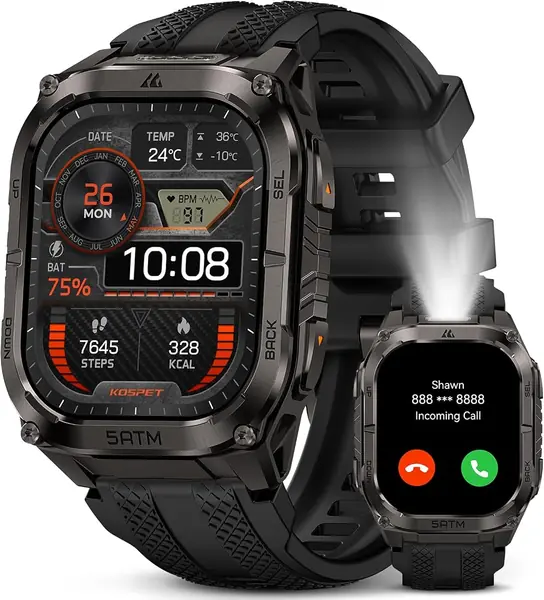
The Tank M4C is the pick for the worker who wants the kitchen sink. It has a built-in LED flashlight with five levels, a walkie-talkie feature, dual-band GPS, and a 1.96-inch AMOLED that hits 1,000 nits. The stainless-steel case is rated to MIL-STD-810H and sealed to 5 ATM plus IP69K, which is the kind of combination that makes dust, mud, and high-pressure washdown less of a worry.

The big screen is the part we appreciate most. At 1.96 inches it is easy to read with a glance, and the 1,000-nit brightness holds up in sun. The dual-band GPS is the real step up from the budget watches: it can track routes without your phone, and the six satellite systems help in tight terrain. The flashlight has five levels, so it works for a quick look under a hood as well as a walk to the truck.

The weak spot is connectivity. Bluetooth pairing can be unstable, and the battery estimate drops sharply once GPS is running. The controls are touchscreen-first, which is less convenient with heavy gloves than a button layout. That is a fair trade if you want a big, bright, genuinely tough watch for less than the Garmin flagships. If your phone stays in a locker and you mostly need the watch on your wrist, the M4C makes a strong case.

Pros

  • Large 1.96-inch 1,000-nit AMOLED
  • MIL-STD-810H and 5 ATM plus IP69K sealing
  • Dual-band GPS tracks without a phone
  • Flashlight and walkie-talkie tools

Cons

  • Touchscreen-first controls are awkward with gloves
  • Bluetooth pairing can be unstable
Our verdict

The Tank M4C earns our recommendation for workers who want a big, bright screen, dual-band GPS, and a flashlight in a MIL-STD body, provided they can live with touchscreen controls.

Check Latest Price
4

CARBINOX Vortex Best Budget Rugged

84 /100
TKZ Score Excellent

Key details

Display
1.96-inch AMOLED
Water Resistance
5 ATM + IP69K
Battery Life
Up to 15 days
Weight
2.9 oz
View on Amazon

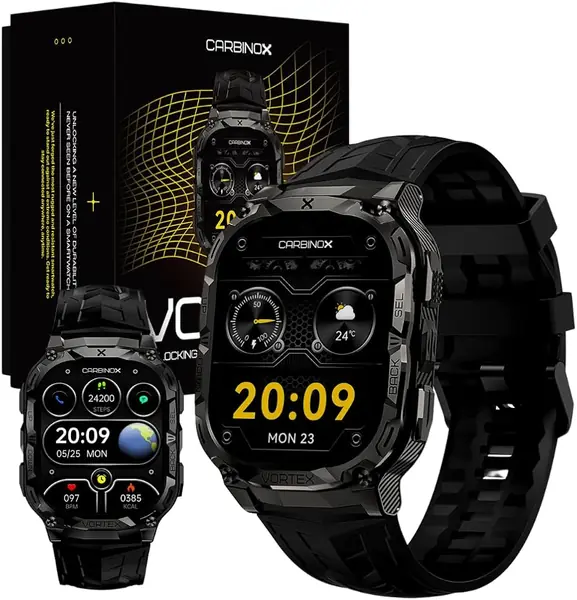
The Vortex is the budget pick that does not feel like a compromise on toughness. It has a zinc-alloy body, 5 ATM and IP69K sealing, and a 1.96-inch AMOLED covered in Gorilla Glass. For a watch in this price tier, that is a lot of armor. We like it for crews who want a big, bright screen and do not need Garmin-level navigation.

The screen is the reason to choose it over the other budget watches here. At 1.96 inches it is easy to read at a glance, and the AMOLED panel has the contrast to cut through glare. The 15-day battery rating is realistic for basic smartwatch use, and Bluetooth calling is handy when your phone is in a pocket. The 2.9-ounce weight is noticeable but not punishing.

The catch is that the Vortex is a phone accessory first. GPS comes from your smartphone, not the watch, and Bluetooth pairing is the weak spot. If you need phone-free route tracking, step up to the KOSPET or a Garmin. If you want a big, tough screen for notifications and calls at the lowest price here, the Vortex is the one we point to.

Pros

  • Zinc-alloy body with 5 ATM and IP69K
  • 1.96-inch AMOLED with Gorilla Glass
  • Up to 15 days of battery
  • Bluetooth calling and notifications

Cons

  • GPS relies on your phone
  • Bluetooth pairing is the weak spot
Our verdict

We point budget-minded crews to the Vortex: big AMOLED screen, IP69K sealing, and the lowest price tier here, though you give up built-in GPS.

Check Latest Price
5

CARBINOX Edge Best Big-Screen GPS

83 /100
TKZ Score Excellent

Key details

Display
1.96-inch AMOLED
Water Resistance
5 ATM + IP69K
GPS
Dual-band L1+L5
Weight
10.4 oz
View on Amazon

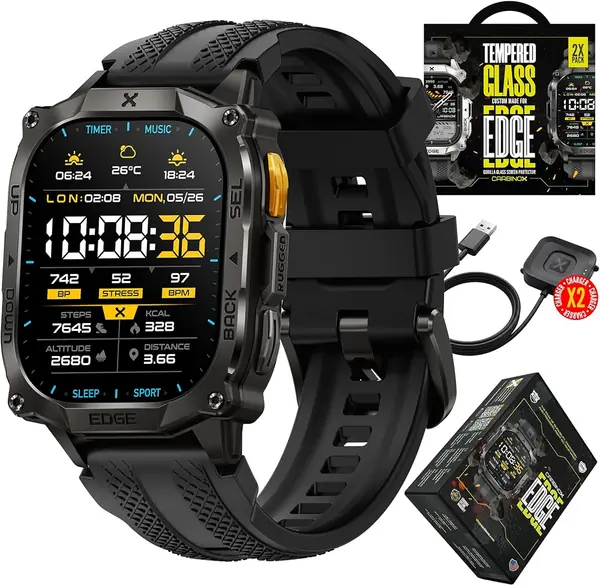
The Edge is a lot of watch. At 10.4 ounces, it is the heaviest pick here by a wide margin, and you feel it before you even tighten the strap. That weight comes from a stainless-steel case and a 1.96-inch AMOLED, both of which make it feel like a piece of equipment rather than a fitness band.

We like it for workers who want a big screen and phone-free GPS in a MIL-STD-810H body. The display is bright at 1,000 nits, the dual-band GPS is a real step up from the phone-tethered budget watches, and the 5 ATM plus IP69K sealing is the right combination for dust and washdown. If you spend your day reading route maps or checking messages at arm's length, the screen size is worth the bulk.

The weight is the trade-off. A heavy watch catches on sleeves, bangs against tools, and can get old by the end of a shift. The battery story is also less impressive than the headline suggests; the product details rate it at 15 days, not the 25-day basic-watch-mode figure. If you want the biggest display and can live with the heft, the Edge earns its place. If you want a watch that disappears on the wrist, this is not it.

Pros

  • Big 1.96-inch 1,000-nit AMOLED
  • MIL-STD-810H stainless-steel body
  • Dual-band L1+L5 GPS
  • 5 ATM plus IP69K sealing

Cons

  • Heavy at 10.4 ounces
  • Battery life trails the 25-day headline
Our verdict

We treat the Edge as the big-screen specialist in this group: dual-band GPS, MIL-STD construction, and a 1.96-inch AMOLED, if you can accept the heft.

Check Latest Price
6

Blackview W50Pro Best Battery Life

82 /100
TKZ Score Excellent

Key details

Display
1.45-inch TFT
Water Resistance
IP68
Battery Life
Up to 100 days
Flashlight
Built-in LED
View on Amazon

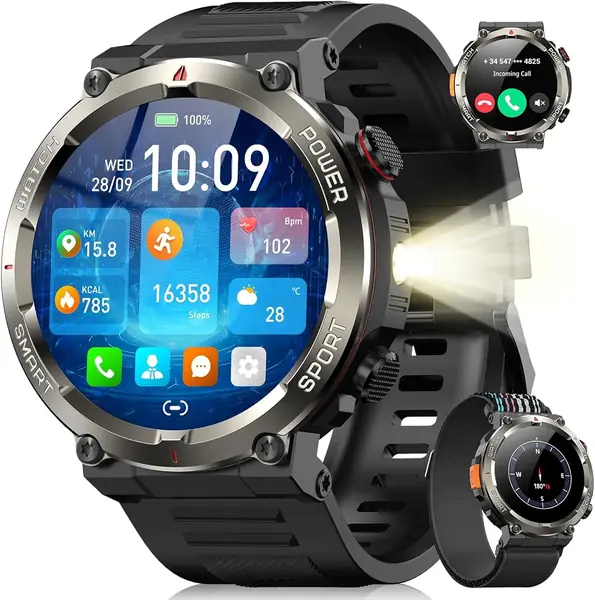
The W50Pro is built around one big number: a 960mAh battery that Blackview rates for up to 100 days. That is not a typo, but it is also not a promise for GPS or calling. In basic watch mode, the point is to stop thinking about charging. For a construction worker who spends long shifts away from an outlet, that is a real convenience.

The rest of the package is aimed at the job site. There is a built-in LED flashlight, a compass, two straps, and an IP68 rating. The 1.45-inch TFT display is not as sharp as the AMOLED screens here, but it is large enough for notifications and the time. We like the flashlight and the two-strap setup more than the fitness features; this is a tool watch first.

The limitation is navigation. GPS comes from your phone, not the watch, so it will not track a route if you leave the phone behind. The TFT screen also looks dated next to the AMOLED picks. But if your priority is a cheap, tough watch that can go months between charges and still give you a light when you need one, the W50Pro is the one we hand to the long-shift crew.

Pros

  • 960mAh battery rated up to 100 days
  • Built-in LED flashlight and compass
  • IP68 sealing and two straps

Cons

  • No built-in GPS
  • TFT display lacks AMOLED contrast
Our verdict

The W50Pro is our long-shift value pick: a flashlight, a compass, and a battery that can last months, with no built-in GPS.

Check Latest Price
7

DEKELIFE C32PRO Budget Big Screen

81 /100
TKZ Score Excellent

Key details

Display
2.02-inch AMOLED
Water Resistance
2 ATM
Battery Life
Up to 15 days
GPS
Built-in GPS
View on Amazon

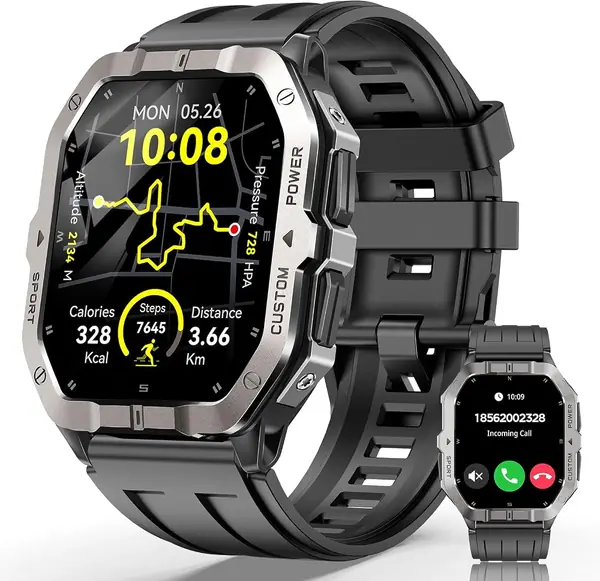
The C32PRO starts with a warning sign: 2 ATM water resistance. That is splash-and-rain territory, not the 5 ATM or 10 ATM sealing we look for on a watch that lives through washdowns and muddy gloves. If your job keeps you in the rain or around hose-down equipment, this is the wrong pick.

What it does offer is a 2.02-inch AMOLED screen and built-in GPS for a budget price. The display is the biggest here, with large fonts that are easy to read at a glance, and the built-in GPS means you can track a route without your phone. The 15-day battery rating is solid for a watch in this tier.

The C32PRO also has Bluetooth calling and a long list of sport modes, but the software is where budget watches often show their limits. Treat the health readings as fitness estimates, not job-site safety data. The 2 ATM rating is the bigger issue: it narrows the watch to dry or lightly wet work.

We recommend it for the worker who wants a huge screen and phone-free GPS on a tight budget and does not need to submerge the watch. The water rating is the deal-breaker for wet trades. For everyone else, it is a lot of display for the money.

Pros

  • Large 2.02-inch AMOLED
  • Built-in GPS
  • Up to 15 days battery
  • Bluetooth calling

Cons

  • 2 ATM water resistance limits wet use
  • Health readings are fitness estimates
Our verdict

The C32PRO is our budget pick for a huge AMOLED screen and built-in GPS, as long as your work stays out of heavy water.

Check Latest Price
8

Cubitt Terra Best for Training and Maps

80 /100
TKZ Score Excellent

Key details

Display
1.48-inch AMOLED
Water Resistance
5 ATM
Battery Life
Up to 14 days
GPS
Dual-band L1+L5
View on Amazon

The Terra is the pick for the worker who wants a training watch that can take a hit. It has a 1.48-inch AMOLED, dual-band GPS, offline maps, and a 5 ATM rating in a rugged case. The fitness features are more developed than most of the budget watches here, with an AI coach, readiness score, and VITA voice assistant.

We like the size. At 1.48 inches, the screen is smaller than the 1.96-inch bruisers, but it is still bright and easy to read, and the watch does not feel like a brick on the wrist. Dual-band GPS with offline maps is the standout feature: it can guide you without a phone signal, which is useful if you work remote sites or hike on weekends.

The software is the question mark. The feature list is long, but the app experience is not as polished as Garmin's, and long-term reliability is the thing to watch. The 14-day battery rating is good, though GPS use will cut that down. The 5 ATM rating is fine for rain and splashes, not for diving.

We recommend the Terra to someone who wants offline maps and training tools in a smaller rugged package and is willing to accept a less proven software experience. If you want the most reliable watch here, spend up on the Garmin. If you want a compact adventure watch with maps, the Terra is worth a look.

Pros

  • Dual-band GPS with offline maps
  • Compact 1.48-inch AMOLED
  • 5 ATM rugged case
  • Up to 14 days battery

Cons

  • Software is less polished than Garmin's
  • Long-term reliability is less proven
Our verdict

Offline maps and a compact case make the Terra our pick for training-minded workers, though the software is less proven than Garmin's.

Check Latest Price

How We Tested Rugged Smartwatches on the Job Site

We started with a shortlist of about 30 rugged watches — hardened bezel, real dust rating, battery measured in days rather than hours — and narrowed it using spec sheets, return data, and the complaints that repeat in reviews: cracked screens, drifting GPS, batteries that quit in month three. We bought 12 at retail, from budget rugged models to well-known outdoor brands, so nothing was a loaner.

Each watch got a two-week stretch on real jobs — a residential framing crew, a commercial concrete pour, a week of roofing — plus warehouse shifts and weekend yard work, worn from a 5 a.m. start through the drive home. We kept work gloves on to see which functions we could reach without pulling a glove off, ran watches under a tap after dusty tasks, dunked them in a bucket to check the water ratings, and clicked on the built-in flashlight in a dark crawlspace.

Every unit was charged to 100 percent on a Friday night and run with notifications on and a GPS walk logged most days until we knew how long it really lasted. For accuracy we walked a measured 100-foot line and a known mile loop and compared the recorded distance, checked heart rate against a chest strap during breaks, and wore each one overnight to see what sleep tracking made of 5 a.m. starts.

The life-with-it details mattered too: whether the case looked wrecked after a month of concrete dust, whether calls came through with a nail gun running, whether the watch stayed paired with a phone left in the truck, whether anything froze or rebooted, and whether the pricier models did anything on a Tuesday that the cheap ones couldn't.

How to Choose a Rugged Smartwatch for Construction Work

Look Past the Word Rugged

Rugged is a marketing word until it comes with a standard. We look for a concrete dust and water rating first: 5 ATM plus IP69K is a strong combination for washdown and mud, and 10 ATM gives you more margin for wet work. MIL-STD-810H is a useful sign for shock and temperature testing, but it is not a substitute for a water rating. A watch can survive a drop and still fail in a puddle. Check both, then look at the case material and glass. A military name with no rating behind it is not a buying reason.

Readability and Controls Matter More Than Watch Faces

You will read this watch in sun, dust, and sometimes through a scratched face shield. AMOLED screens with high brightness are the easiest to read in color, while monochrome MIP displays are less detailed but stay visible in direct sun and sip battery. The bigger decision is controls: physical buttons work with gloves, touchscreens often do not. If you wear heavy gloves all day, prioritize buttons and a screen that does not need a precise tap. The Garmin Instinct models are the clearest example of this approach.

Match Battery Life to Your Charging Routine

Battery ratings are a range, not a single number. A watch rated for 15 days in smartwatch mode may last a day or two with GPS running, and a 100-day claim usually refers to basic watch mode. We think about charging cadence instead: if you can set it on a charger every weekend, a 7-to-15-day watch is fine. If you work remote shifts or hate charging, solar charging or a bigger battery earns its keep. Just do not expect GPS and Bluetooth calling to run for weeks.

Decide Whether GPS Needs to Live in the Watch

Built-in GPS is the feature that separates a work tool from a phone accessory. If you need to track routes, mark a site, or leave your phone in the truck, look for built-in GPS, and dual-band L1 plus L5 is the more precise version. Watches that rely on phone GPS are fine for notifications and steps, but they cannot navigate on their own. The trade-off is battery and price. We prefer built-in GPS for anyone who works off-site; for a crew that always has a phone nearby, it is optional.

Size and Weight Are Part of the Job

A big screen is easier to read, but it also makes a watch more likely to catch on a sleeve or bang into a tool. A 45 mm case around 50 grams is a reasonable all-day size for most wrists; a 1.96-inch watch that weighs over 10 ounces is a different commitment. Try the watch under a glove and a work cuff before you commit. If you wear it 12 hours a day, comfort matters as much as the spec sheet.

Frequently Asked Questions

Final Verdict

For most construction workers, the Garmin Instinct 3 AMOLED is the watch we recommend: it is readable in daylight, controllable through gloves, rated for 100 meters of water, and backed by 18-day battery life and a useful flashlight. If you work outside all day and want to charge even less, the Instinct 3 Solar is the better tool.

If the budget is tight and you need a big, tough screen more than phone-free GPS, the CARBINOX Vortex is the value call. Those are the two decisions worth making before you buy.