Best Home Bluetooth Speakers of 2026

A home speaker has to earn its shelf space. This isn't the puck you toss in a tote; it sits in one corner for years, so the questions get pickier: will it fill the living room without going muddy at volume, does it look intentional next to your books, and will it still connect from the kitchen? I've had speakers that sounded great for a week, then stuttered whenever the microwave ran. The good ones disappear — you press play and stop thinking about them.

Over six months, my team and I lived with 10 of these speakers, wired into turntables, paired in stereo, and running through entire workdays. The differences showed up in the small things, not the spec sheet. Wattage is the number shoppers fixate on and the one that predicts the least; a well-tuned woofer beats a bigger, sloppier driver in a room with thin walls. What separates them is how they handle the boring parts: setup, input switching, holding a signal, whether the app earns a second visit.

The Best Home Bluetooth Speakers

1

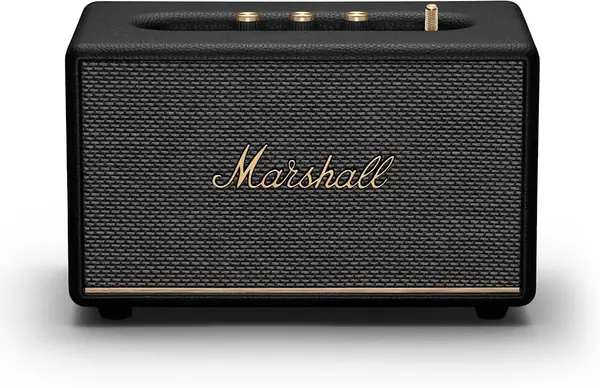
Marshall Acton III Best Overall
94 /100
TKZ Score Outstanding

Key details

Power
Corded electric
Dimensions (D X W X H)
5.91 x 10.24 x 6.69 in
Max Output
60 watts
Inputs
Bluetooth, 3.5mm aux
View on Amazon

A living room is the hardest room in a house to fill from a shelf, and the Acton III is the speaker here that does it from one box. Marshall rates it at 60 watts through a 4-inch woofer and a 0.75-inch tweeter, and the cabinet is 10.24 inches wide, so it takes one spot on a bookcase instead of the two a stereo pair needs. At 6.2 pounds it also stays where you put it.

What keeps us coming back to it is the top panel. Bass and treble are physical knobs rather than app sliders, and the change is audible as you turn them — useful in a room with a lot of glass, where a fixed speaker goes thin, or one with heavy carpet, where it turns muddy. Pairing asks for no account and no app: hold the button, pick it on your phone, play.

The inputs are where it stops: Bluetooth and a 3.5mm aux jack, nothing optical. If the speaker shares a shelf with a television or a turntable that wants a digital connection, the Edifier pair is the better buy, and it costs less.

What the money buys is the combination: a finish that reads as furniture, headroom that keeps a dinner party out of distortion, and one cabinet to place rather than two. We keep it in the living room and stop thinking about it, which is the highest compliment a home speaker gets.

Pros

  • Fills a living room from one small cabinet
  • Bass and treble knobs you can hear working
  • Looks like furniture on a shelf

Cons

  • Corded only, with no battery
  • First pairing can take several attempts
Our verdict

Start here if one box has to fill a living room: 60 watts through a 4-inch woofer, and a cabinet that looks like a small guitar amp instead of a gadget.
Check Latest Price
2

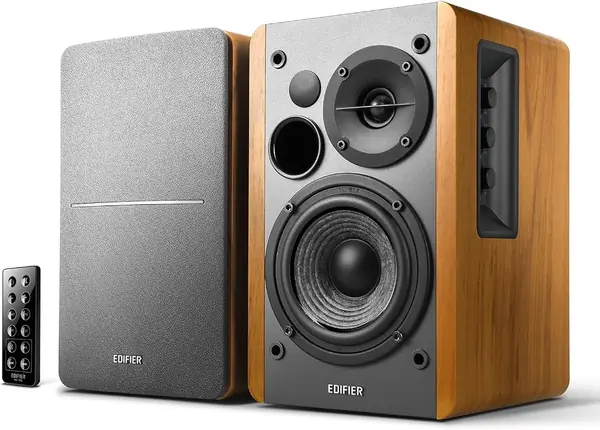
Edifier R1280DB Best for TV and Turntable

93 /100
TKZ Score Outstanding

Key details

Power
Corded electric
Max Output
42 watts RMS
Inputs
Bluetooth, optical, coaxial, dual RCA
Drivers
4-inch woofer, 13mm tweeter
View on Amazon

Two cabinets, one amplifier, and a cable between them: the R1280DB is what we point to when someone wants stereo separation rather than a single box approximating it. Edifier rates the pair at 42 watts RMS with a 4-inch woofer and a 13mm silk dome tweeter in each cabinet, and it costs about what the single-box picks here cost — that trade is the whole argument.

The inputs are why it wins for a television or a desk: optical and coaxial for a TV or computer, dual RCA for a turntable with a built-in preamp, and Bluetooth for everything else. Setup is one cable between the cabinets, one to the wall, then pair — the least fiddly install in this group, and the reason it ends up in workshops and home offices as often as living rooms.

Where it stops is the low end. Four-inch drivers handle voices, acoustic music, and dialogue well and do not dig into hip-hop or an action movie the way a 5-inch woofer does; in a den or a bedroom that is a fair trade for the stereo image and the money. The wood-grain finish is the other reason it earns a shelf rather than a corner.

Pros

  • True stereo separation from two cabinets
  • Optical, coaxial, RCA, and Bluetooth inputs
  • Sets up with one cable and a pairing

Cons

  • Remote is small and often unresponsive
  • Bass and treble knobs sit on the cabinet
Our verdict

If a TV, turntable, or desktop is part of the setup, these are the ones we buy: a real stereo pair with optical and RCA inputs for single-box money.

Check Latest Price
3

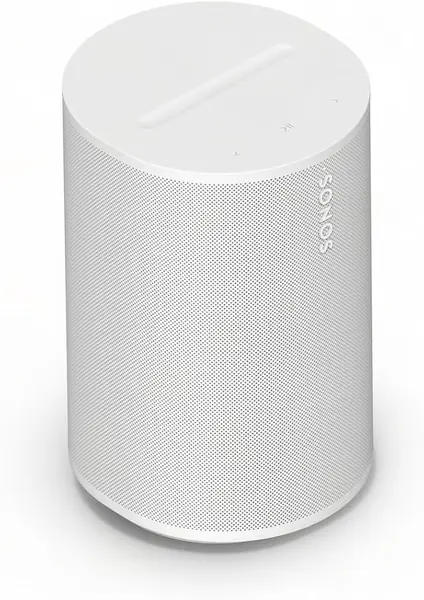
Sonos Era 100 SL Best for Multi-Room

90 /100
TKZ Score Outstanding

Key details

Power
Corded electric
Dimensions (D X W X H)
4.72 x 5.19 x 7.22 in
Drivers
Dual angled tweeters, 4-inch midwoofer
Connectivity
Bluetooth, Wi-Fi
View on Amazon

The Era 100 SL is a WiFi speaker first and a Bluetooth speaker second, and that order is the point. It streams through the Sonos app, joins a Sonos system, and pairs with a second unit for stereo or with a soundbar as rears. Bluetooth is there for the friend who wants to play from a phone that is not on the network.

Dual angled tweeters and a 4-inch midwoofer in a 7.22-inch cylinder give it more low end than the size suggests, and Trueplay tuning adjusts the output to the room. That matters in a kitchen full of hard counters and cabinet fronts, where a fixed speaker tends to boom, and it is why two of these can sit in very different rooms and still sound right.

What settles it for us is the missing microphone. This is the Sonos to buy if you want the ecosystem without an always-listening assistant in the bedroom, and the tuning and stereo pairing do not cost extra for it. Check what you already own before ordering: this generation does not join a system built on older Sonos speakers, and finding that out after delivery is more annoying than checking first.

Pros

  • WiFi streaming with Bluetooth as backup
  • Two units make a true stereo pair
  • No microphone anywhere on the speaker
  • Room tuning through Trueplay

Cons

  • Most control runs through the app
Our verdict

Choose this one if the music has to follow you through several rooms over WiFi, and if a microphone-free speaker matters for the bedroom.

Check Latest Price
4

JBL Authentics 200 Best Smart Speaker

89 /100
TKZ Score Excellent

Key details

Power
Corded electric
Dimensions (D X W X H)
6.59 x 10.48 x 6.76 in
Connectivity
Bluetooth, Wi-Fi, AirPlay, Ethernet
Woofer
5 inches
View on Amazon

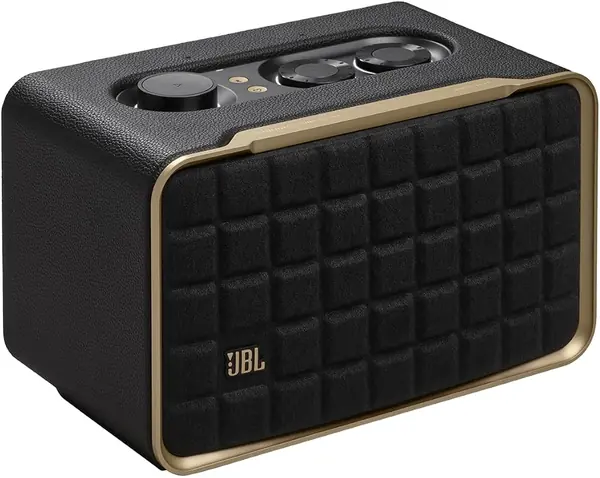
A 5-inch woofer, 25mm tweeters, and a 6-inch passive radiator behind a leather-look wrap and an aluminum frame: the Authentics 200 is a retro cabinet that also happens to be the most connected speaker here. WiFi streaming with AirPlay, Alexa and Google Assistant built in, Ethernet if your wireless is patchy, Bluetooth when you want it. At 10.48 inches wide it wants a counter rather than a narrow bookshelf, which suits a kitchen or a desk.

The dials on top handle volume, bass, and treble without the app, which not every speaker here offers, and the aluminum and leather finish is the rare smart speaker that does not look like a hockey puck. Set against the Sonos, this one gives you more streaming routes and a bigger cabinet for about the same outlay; the Sonos is the steadier system if you want one that never asks a question.

Pros

  • WiFi, AirPlay, Ethernet, and Bluetooth in one box
  • Top dials for volume, bass, and treble
  • Voice control without a separate smart speaker

Cons

  • Connection can drop after inactivity
  • No power button; standby or unplug
Our verdict

Kitchen counters and home offices are where it makes most sense: WiFi streaming, AirPlay, and two voice assistants mean no reaching for your phone.

Check Latest Price
5

Harman Kardon Onyx Studio 9 Best to Carry Room to Room

88 /100
TKZ Score Excellent

Key details

Dimensions (D X W X H)
5.12 x 11.39 x 11.32 in
Max Output
50 watts
Driver
13 cm
Battery
Up to 8 hours
View on Amazon

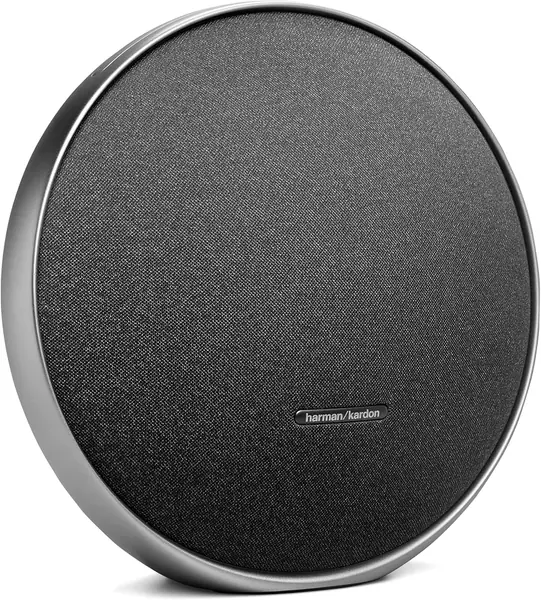
A speaker that follows you around the house has to be one you can pick up and set down anywhere, and the Onyx Studio 9 gets close: a rechargeable battery rated at 8 hours, 9.4 pounds, and a disc you grab by the rim. Power it on and it recalibrates to the room it is in, which is the difference between a portable that sounds thin on tile and one that does not.

Fifty watts through a 13 cm driver gives it more low end than a 9-pound speaker has any right to, and for a patio dinner we take this over a bigger box that cannot leave the living room. Pairing a second unit over Auracast widens the stage, which is the upgrade path if you want stereo outside rather than a louder single speaker.

The shape is the cost. At 11.39 inches across it wants a side table, a counter, or the floor — it will not slot onto a bookshelf next to books the way the Marshall does, and Bluetooth sometimes needs a second attempt after the unit has been idle. Both are easy to live with if the speaker has a home in each room it visits and gets carried between them.

Pros

  • Built-in battery rated at 8 hours
  • Re-tunes itself every time it powers on
  • 50 watts and genuine low end for the size
  • Auracast pairing for a second unit

Cons

  • Battery can fall short of the rated 8 hours
Our verdict

Buy it if the speaker moves — kitchen to bathroom to patio — and you want it to re-tune itself each time; 50 watts and a real battery make that work.

Check Latest Price
6

Saiyin DS6701 Bookshelf Speakers Best Budget Pair

87 /100
TKZ Score Excellent

Key details

Max Output
80 watts (40W x 2)
Inputs
Bluetooth, optical, coaxial, RCA
Dimensions
150 x 170 x 240 mm
Subwoofer Output
Yes
View on Amazon

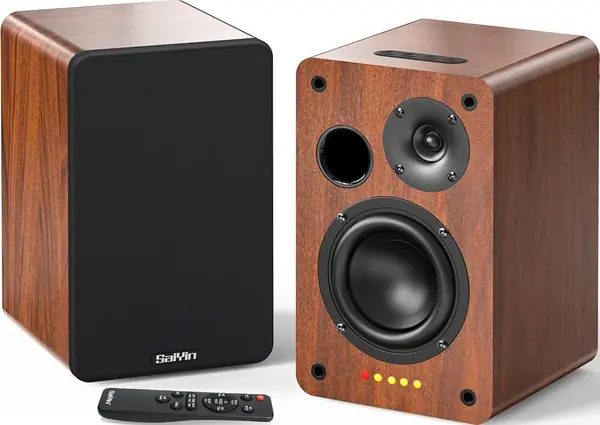
Eighty watts across two cabinets, a 4-inch woofer and a silk dome tweeter in each, and a subwoofer output — for the least money of any pair here. That output is what separates it from the Edifier set: if you want to add a subwoofer later, this is the budget pair that lets you, and at this size it is the difference between a system you grow and one you replace.

Setup is the best thing about it. One cable between the cabinets, one to the wall, then Bluetooth 5.3 finds your phone; optical and coaxial are there for a TV or a computer, RCA for a turntable. The cabinets weigh 10.2 pounds together and each stands about 240mm tall, which is why so many of these end up on desks and workbenches.

Eighty watts is plenty for a den, a bedroom, or a desktop and thin for a big open-plan living room — the honest limit of a budget pair with 4-inch drivers. For a first stereo setup, a workshop, or a spare-room television, we think it is the value pick of this group.

Pros

  • 40 watts per cabinet from 4-inch woofers
  • Optical, coaxial, RCA, and Bluetooth inputs
  • Subwoofer output for adding bass later

Cons

  • Remote needs a clear line of sight
Our verdict

The cheapest way into real stereo here, and the only pair with a subwoofer output — we recommend it for a first setup in a den or spare room.

Check Latest Price
7

Bose Lifestyle Ultra Best for Small Shelves

84 /100
TKZ Score Excellent

Key details

Power
Corded electric
Dimensions (D X W X H)
6.59 x 4.77 x 7.27 in
Connectivity
Bluetooth, Wi-Fi, AirPlay
Weight
3.7 lb
View on Amazon

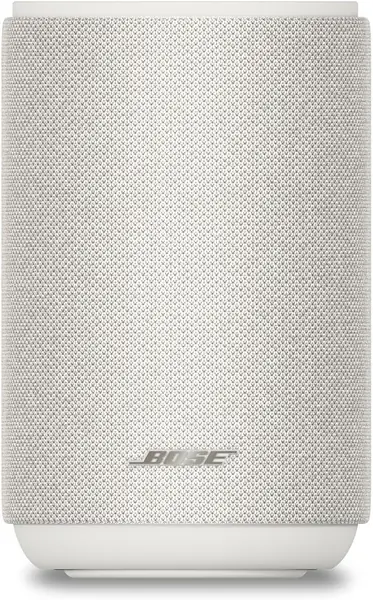
At 7.27 inches tall and 3.7 pounds, the Lifestyle Ultra takes less shelf than anything else here with this many ways in: AirPlay, Google Cast, Bluetooth, and Alexa+ built in, plus adjustable EQ in the app. It is the smallest cabinet in this group with a claim to filling a room.

Bose pitches TrueSpatial as a wider soundstage than a single cabinet normally manages, and CleanBass for the low end; two of them pair for stereo, and more can join a multi-room setup with a soundbar and subwoofer in the same family. That flexibility is the point — this is a building block for a system more than a one-off speaker.

Setup is the part to plan for. The app drives everything, pairing two into stereo takes patience the first time through, and the friction arrives when a phone hands off between WiFi and Bluetooth. Touch controls and voice commands cover the rest once it is running, which is where the speaker is happiest.

Our read: the sound and the footprint justify it in a bedroom, den, or kitchen, and the streaming menu is broader than anything else here. If you do not need AirPlay or a voice assistant, the Marshall gives you more speaker for less; the Bose earns its money when the shelf is small and the ways in are the point.

Pros

  • AirPlay, Google Cast, Bluetooth, and Alexa+ in one box
  • Adjustable EQ in the app
  • Only 3.7 pounds and 7.27 inches tall

Cons

  • Streaming can drop when networks switch
Our verdict

For a small shelf where you want AirPlay, casting, and voice control without a stack of gear, it earns its price; expect to fiddle with setup.

Check Latest Price
8

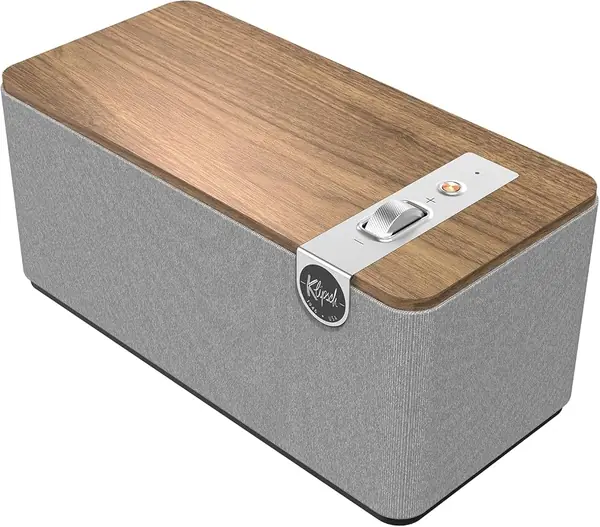
Klipsch The One Plus Best for Design-Led Dens

83 /100
TKZ Score Excellent

Key details

Power
Corded electric
Drivers
Two 2.25-inch full-range, 4.5-inch woofer
Bluetooth Range
Up to 40 feet
Dimensions (W X D X H)
12 x 6.39 x 6 in
View on Amazon

Klipsch builds this one like a piece of furniture: real wood veneer over the cabinet, metal switches and a knurled volume knob on top, and 12 inches of width that reads as a sideboard accessory rather than a computer peripheral. In a den or a dining room it is the one here you would leave out on purpose.

Inside is a 2.1 system — two 2.25-inch full-range drivers and a 4.5-inch woofer, biamplified — and Bluetooth 5.3 rated to 40 feet, the longest range in this group. In a kitchen you can leave the phone on the counter and walk to the far end of the house without the signal breaking.

The Klipsch Connect app handles EQ and saved presets, and it is where the rough edges live: a unit that shuts itself off mid-album is the sort of thing to test inside the warranty window rather than a month later, and the volume knob has detents not everyone enjoys. Neither is a dealbreaker in a room where the speaker mostly plays background music.

What tips it for us is the finish. This is the one here that looks intentional in a room with real furniture, and the sound is full enough for a den without a subwoofer. If the speaker will be seen, it earns its quirks; if connection stability matters more than how it looks, the Marshall is the safer buy.

Pros

  • Real wood veneer and metal controls
  • 2.1 system with a 4.5-inch woofer
  • Bluetooth 5.3 rated to 40 feet

Cons

  • Bluetooth can drop and need re-pairing
  • Can shut itself off during playback
Our verdict

We recommend it when the speaker is going on display: real wood veneer, tactile knobs, and a 2.1 system in a cabinet 12 inches wide.

Check Latest Price

How We Tested Home Bluetooth Speakers

We started by pulling every home speaker we could find in the midrange and up, then cut anything with a dead app, a single input, or a review page haunted by the same failure over and over. That left 10 units, tested over six months. Each one lived in a real room rather than on a bench: a living room with a sofa and a rug, a kitchen counter, a desk beside a monitor, and — for the models with a built-in battery — a back patio.

Setup was timed from slicing the tape on the box to hearing the first song, including the app download and any firmware update. We paired each speaker to an iOS phone and an Android tablet, walked to the far end of the apartment to find where the signal broke, and re-ran the test with the microwave and the router going to see which ones stuttered. Input switching got the same treatment: jumping from Bluetooth to a turntable to a TV mid-song and counting how many taps it took.

For sound, the same short playlist went through every unit — a bass-heavy track, a sparse acoustic vocal, a dense rock mix — at low, normal, and maximum volume, and we listened for bass turning flabby, vocals getting buried, or a speaker going harsh before it went loud. Where a maker allowed it, we paired two units in stereo, which is the upgrade most shoppers don't realize they're buying.

Appearance was judged the way you'd judge furniture: how much shelf it eats, whether the grille and knobs feel like metal or plastic, whether fingerprints show. We kept running notes on value too — what the money buys in inputs, tone controls, and whether a remote comes in the box or you're expected to reach for your phone.

How to Choose a Home Bluetooth Speaker

One Box or a Pair

A stereo pair puts the left and right channels in separate cabinets, which is why the Edifier R1280DB and the Saiyin DS6701 produce an image that a single box only approximates. The cost is a second footprint and a cable running between the two speakers.

If a console, desk, or pair of shelves has room for cabinets a few feet apart, buy the pair — the separation is worth the wiring. If the only spot is a bookcase shelf or a narrow side table, a single speaker like the Marshall Acton III fits where two cabinets never will, and it will sound more coherent than two speakers jammed together.

What Wattage Actually Tells You

Wattage is measured differently from brand to brand, and the largest number on a spec sheet is often the amplifier's rating rather than anything you will hear in the room. Driver size and cabinet volume tell you more about how a speaker fills space.

A 4-inch woofer in a small cabinet suits a bedroom, den, or kitchen. A 5-inch woofer moves enough air for an open living room. Buy for the room you have, and treat wattage as a tiebreaker within one maker's lineup rather than as a ranking across brands.

Count the Inputs You Actually Need

Bluetooth is the baseline; everything else is about what you plan to connect. Optical or coaxial is what a television or desktop computer wants, and it also solves a trap: Bluetooth adds delay that shows up as lip-sync drift on video, so a Bluetooth-only speaker is the wrong tool for movie night.

RCA is for a turntable, and that comes with its own trap — most turntables need a phono preamp before the signal reaches a speaker, so check whether yours has one built in. WiFi, on the Sonos Era 100 SL and the JBL Authentics 200, buys multi-room streaming and a steadier connection than Bluetooth.

Plug-In, Battery, or Both

A speaker that never leaves the living room should be plug-in. Mains power allows a bigger cabinet, a bigger woofer, and no battery quietly aging on a shelf.

Battery models like the Harman Kardon Onyx Studio 9 buy the ability to carry music to the patio or the bathroom, and they charge for it in weight, cost, and a runtime rating that shortens as volume climbs. Buy battery only if the speaker genuinely moves; if it moves twice a year, put the money into drivers instead.

Measure the Shelf Before You Order

Width gets the attention and depth is what ruins a placement. The Klipsch The One Plus is 6.39 inches deep and the Harman Kardon Onyx Studio 9 is 11.39 inches across, so a narrow console takes one and not the other; the Bose Lifestyle Ultra is 4.77 inches wide, which is why it disappears onto a small shelf.

Tape the footprint onto the surface before you buy, check the height against the shelf above, and look at the weight rating if the speaker sits on a floating shelf — the Edifier pair weighs 12.9 pounds together.

Frequently Asked Questions

Final Verdict

Start with the Marshall Acton III. It fills a living room from one cabinet a little over 10 inches wide, the bass and treble knobs let you correct a bright or boomy room in seconds, and it looks like it belongs on the shelf rather than in a rack.

Change the requirement and the pick changes. If a TV or a turntable needs optical or RCA, the Edifier R1280DB gives you real stereo separation for less, and if the music has to follow you through several rooms over WiFi, the Sonos Era 100 SL is the one to buy.