Best GPS Trackers for Kids of 2026

Every parent I know has a version of the same ten minutes: a headcount at the museum comes up one short, the bus runs late, and your stomach drops before anything has actually gone wrong. A kids' GPS tracker doesn't fix bad traffic or a distracted afternoon, but it can shorten that panic to a glance at your phone.

I've spent the past eight months testing 12 of these with my own kids, and my team ran the same checks with theirs. The spec sheet never tells you the two settings that decide everything: how often the device pings its location, and whether the battery survives that pace until pickup.

The other half of the equation is your kid, who turns out to be the real gatekeeper — a watch that looks babyish, feels chunky, or buzzes mid-math class gets buried at the bottom of a backpack by October. The ones that stick around earn it twice: a location you trust and a device they'll actually keep wearing. The picks below cleared both bars.

The Best GPS Trackers for Kids

1

TickTalk 6 Kids Smartwatch Best Overall
87 /100
TKZ Score Excellent

Key details

Screen
1.6-inch AMOLED
Calling
Calls, video, and real SMS
Approved Contacts
Up to 100
Rated Battery Life
Up to 48 hours
View on Amazon

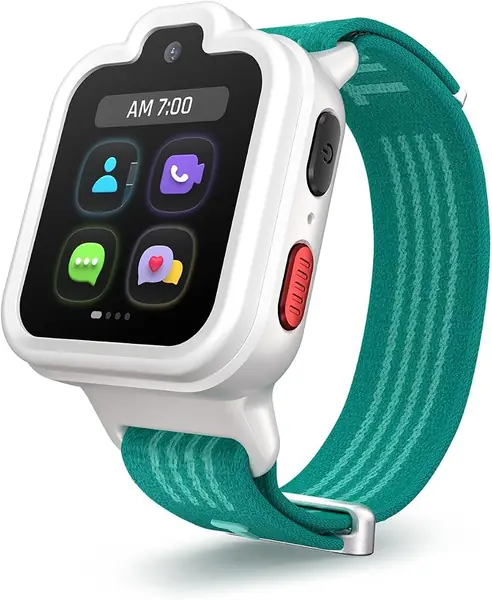
Most kids smartwatches keep conversation inside the parent app: your child taps a face, the call comes to your phone, and messages live in the maker's software. The TickTalk 6 sends a real SMS to a real phone number, so a grandmother or a babysitter replies from the phone already in her pocket. FaceTalk video from the 5MP camera and an LTE walkie-talkie round out a device that behaves like a small phone rather than a one-way leash.

That range is why it is our top pick, but the daily handling is what confirmed it. Setup runs in minutes, the 1.6-inch AMOLED screen is bright enough for daylight and big enough for a child to tap accurately, and the app puts contacts, school mode, and location where a parent can reach them at 7:40 on a school morning. You can approve up to 100 contacts and give a caregiver limited access, so help can call without holding the keys to everything.

Battery is rated for up to 48 hours, generous for an LTE watch; plan on a nightly charge once calling and live location are in regular use, because a watch that dies before dismissal is worse than no watch at all. Small touches earn their keep too. The band is machine washable, which is the difference between a wristband that gets worn and one that gets abandoned in March, and a protective case comes in the box.

Location is the part that wobbles. A fix can land miles from where your child actually is, especially with the watch in school mode, so treat the live dot as a neighborhood marker and let safe-zone arrival alerts carry the message that they got there. For a watch that also calls and texts this well, that is a trade we accept.

Pros

  • Real SMS to ordinary phones, no app needed
  • Up to 100 approved contacts with school mode
  • Bright 1.6-inch AMOLED screen and quick setup

Cons

  • Location fixes can land miles off in school mode
Our verdict

We recommend the TickTalk 6 for most families: it places calls, sends real texts, and reports location on one line a six- to twelve-year-old can operate.
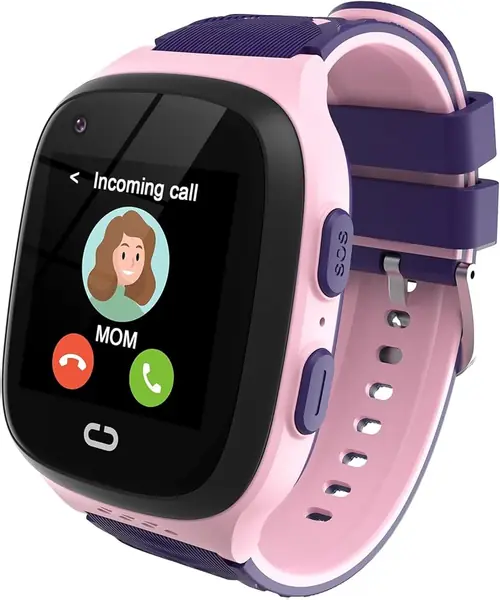
Check Latest Price
2

AngelSense GPS Tracker Best for Kids Who Won't Wear a Watch

84 /100
TKZ Score Excellent

Key details

Alerts
AI departure and arrival alerts
Two-way Voice
Auto-answer speakerphone
Wearing Style
Sleeve with non-removable fasteners
Service Included
12 months
View on Amazon

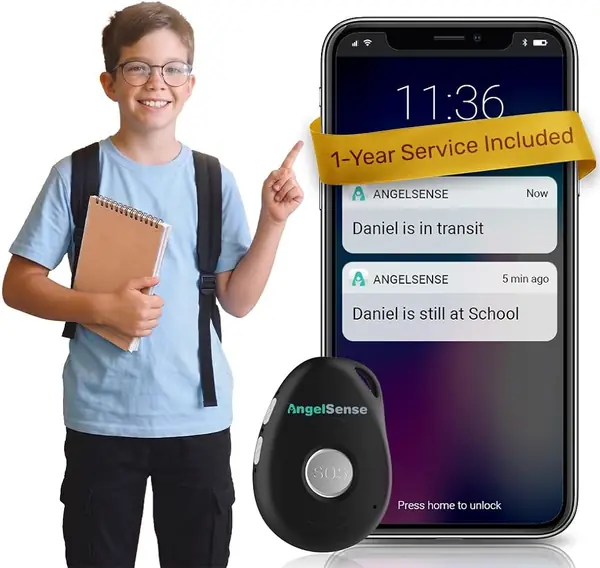
AngelSense is built around the problem the watches here cannot solve: the child who takes things off. The tracker sits in a soft sleeve that fastens shut and needs a magnetic key to open, so it stays where you put it through a school day, a long walk, or a meltdown.

What it does from that position is the impressive part. You get live location and a full route history on a phone, tablet, or PC, and the app learns the routine, home, school, the bus, so an unexpected departure or a late arrival raises an alert before you think to open a map. First responder alerts, safe ride monitoring, and fall detection are in there too. The feature we liked most is the speakerphone that answers itself: you can listen in, or talk, without a nonverbal child pressing anything.

The costs are real and worth stating plainly. It wants a daily charge. Cellular coverage decides whether it works at all, and a dead zone means no signal rather than a degraded one. The first year of service is bundled and the plan after it is not, so the true price is the device plus years of service. In exchange you get the one device here that keeps reporting when the child is least cooperative.

It is not a phone: no dial pad, no texting a friend, no games. The auto-answer speakerphone that makes it useful is also the feature a school office is most likely to question, so expect a conversation before your child wears it in.

Pros

  • Fastens on and needs a magnetic key to remove
  • AI alerts for departures, late arrivals, and unfamiliar places
  • Two-way voice that answers without the child touching it

Cons

  • Needs charging every day
  • Service plan required after the included year
Our verdict

For a child who will not keep a watch on, or who elopes, this is our pick: it stays fastened, and its alerts reach you before you start searching.

Check Latest Price
3

AIWIEP G31 Kids Smart Watch Best Budget

83 /100
TKZ Score Excellent

Key details

Screen
1.54-inch touchscreen
Water Resistance
IP67, 1-meter depth
Positioning
GPS and cell-tower (LBS)
Battery Capacity
650 mAh
View on Amazon

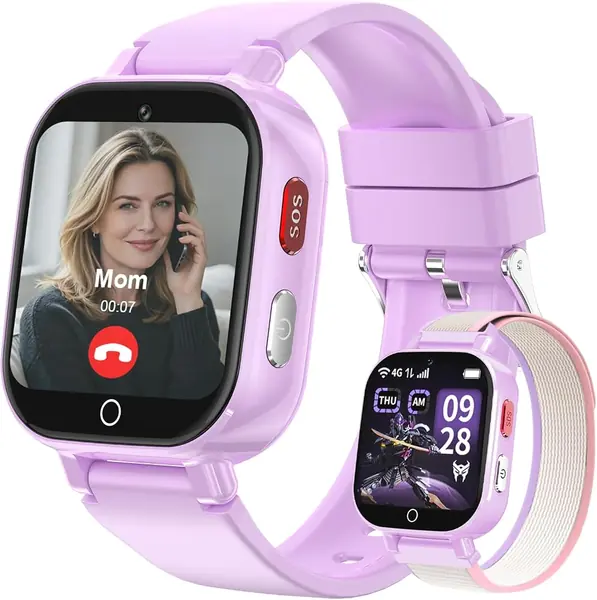
Cheapest of the five here, and the one we point parents to when the child is five rather than ten. The 1.54-inch touchscreen uses big, obvious icons, and a kindergartener can find the call button, the camera, and the games without a lesson first.

The basics are all present: two-way video and voice calling, one-key SOS, GPS with cell-tower positioning behind it, school mode, a camera, and a 12-month warranty, which is more coverage than one pricier watch in this group offers. We especially like that SOS needs a five-second press, because a button a small kid can trigger by bumping a doorframe is a button that cries wolf.

The compromises are where the money went. Water resistance stops at IP67 with a one-meter depth rating, which covers handwashing and rain and rules out the pool. Location leans on cell-tower estimates as well as GPS, so fixes inside a building will be coarser than on the walk to school. And 650 mAh is a small battery for a 4G watch; the two-hour charge is quick, but plugging in becomes part of the bedtime routine.

For a first watch on a small wrist, that is the right set of trades. Nothing here is precious enough to panic about if it ends up at the bottom of a backpack, and the SOS button and calling are the reason to buy it while the games and camera are the reason a kid agrees to wear it.

Pros

  • Big icons a five-year-old can navigate
  • Least expensive of the picks here
  • SOS needs a deliberate five-second press

Cons

  • IP67 only, so it stays out of the pool
  • Coarser location indoors with cell-tower positioning
Our verdict

The G31 is our budget choice: the least expensive way into a watch a young child can actually operate, with a shallower water rating that reflects the price.

Check Latest Price
4

DXPICR 4G Kids Smart Watch Video Calls on a Budget

82 /100
TKZ Score Excellent

Key details

Screen
1.4-inch touchscreen
Water Resistance
IP68
SIM
Card included
Positioning
GPS, GLONASS, BeiDou, Galileo
View on Amazon

Our top pick costs about twice as much. The DXPICR undercuts it and does two things the TickTalk does not: a SIM card comes in the box, and location draws on GPS, GLONASS, BeiDou, and Galileo rather than GPS alone.

The SIM is the detail that matters most, because activation is where kids' watches go sideways. You buy the watch, then discover it needs a nano-SIM and a data plan before it will call anyone or report anything, and one in the box removes an errand and a weekend of waiting. The limit is geographic: this watch is built for US networks, so it is not the one you pack for a trip abroad.

The rest is a well-equipped kids smartwatch. A 1.4-inch touchscreen, 4G video and voice calls, an SOS button, class mode, contact blocking, and a three-year warranty, the longest coverage in this group. We are less convinced by the AI extras, a voice assistant, translation, and image recognition, which a child tries twice before going back to the camera and the video call.

What gives us pause is reliability. Watches that will not power on or stop taking a charge turn up against this model, and that is the one failure a location device cannot afford. Run it hard for the first week, with the return window still open, before it becomes the thing your child wears to school.

Pros

  • SIM card included, so activation is one step shorter
  • IP68 case with four-satellite positioning
  • 4G video calling with a three-year warranty

Cons

  • US networks only
  • Some units stop charging or powering on
Our verdict

Choose the DXPICR for 4G video calls, an IP68 case, and a SIM in the box, provided you are in the US and you test it hard in the first week.

Check Latest Price
5

Transformers Kids Smart Watch Best for Big Screen for Small Hands

81 /100
TKZ Score Excellent

Key details

Screen
1.83-inch touchscreen
Water Resistance
IP68, 1.5-meter depth
SIM
Nano SIM required
Charge Time
10 hours
View on Amazon

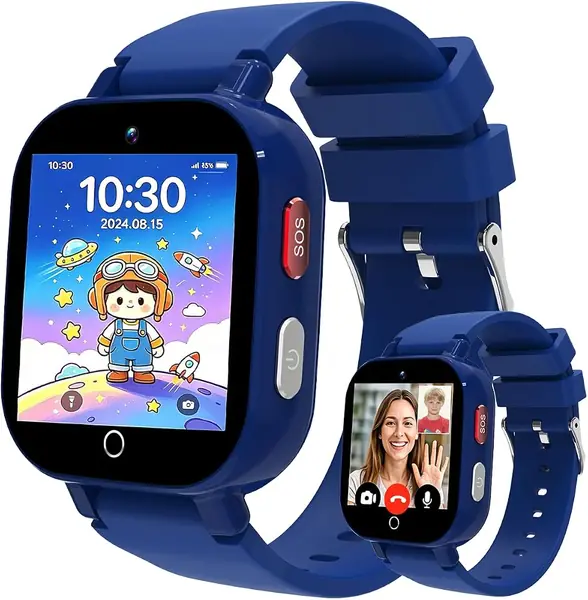
At 1.83 inches, the screen here is the largest in this group by a wide margin, closer to a small phone than to the 1.4-inch display on the DXPICR. For a six-year-old aiming at icons, that is a gift. On a nine-year-old's wrist it looks like a tablet strapped on, and we minded the bulk more than we enjoyed the readability.

The case is rated IP68 with a 1.5-meter water resistance depth, the deepest figure here, and it comes with a dual-strap design meant to stay put through sports. Calls, video, GPS tracking, SOS, and class mode are on board, and it takes a nano-SIM with data, the same setup as everything else in this group.

Two things to know before ordering. A full charge runs to 10 hours, slow enough that the routine has to be overnight rather than a top-up before school. And there is no warranty on it at all, which is worth weighing against the G31, a cheaper watch with 12 months of coverage.

What is left is a straightforward trade: a big, waterproof, easy-to-tap watch with no safety net if it fails. For a young child who mainly needs to call home and be findable, that is a fair deal; spend more and you are buying support and a better app as much as hardware.

Pros

  • Largest screen in this group at 1.83 inches
  • IP68 with a 1.5-meter depth rating
  • Calls, video, GPS, and SOS on 4G

Cons

  • 10-hour charge time
  • No warranty
Our verdict

A big screen and a genuinely waterproof case make this a fair choice for a younger child, if you can accept no warranty and a very long charge.

Check Latest Price

How We Chose and Tested the Best GPS Trackers for Kids

We started by pulling every kids' tracker we could find and filtering hard: 4G LTE connectivity, since older 2G units are already going dark in parts of the country; an SOS button a small hand can actually press; and a service plan we could price out for a full year. That left 12 devices, from simple wristwatches to belt-clip units for kids who refuse to wear a watch. We tested them for eight months.

Testing happened where these things actually live: school drop-off, soccer practice, a crowded theme park on a Saturday, the mall, and a weekend at Grandma's. We timed how long a fresh location took to appear and whether the pin landed on the right side of the building, had our kid testers walk to a corner and stand still to see if the dot settled or drifted, and checked in from indoors and from a parking garage where signal tends to fall apart.

For call functionality and connectivity, we called at set times and noted whether the watch rang through on the first try, how clearly we could hear a 7-year-old, and whether the kid could answer without an adult talking them through it. Battery got tracked from 7 a.m. to bedtime with locating set as frequently as the app allows, because a watch that dies before pickup is worse than no watch. Waterproofing claims earned a minute under the running faucet and a check for fogging behind the screen.

The kids wore them daily, which is the only honest test of appearance and comfort — a chunky band that snags a sleeve is gone by week two. We watched whether the games, music, camera, and video calling were a novelty that wore off or something they came back to, and whether the fun features got in the way of answering a call. Value got tallied last: purchase price plus a year of service, weighed against how often we actually reached for it.

How to Choose a Gps Tracker for Kids

Start With What Your Child Will Actually Wear

Every device here only works if it is on the child. A watch is the better object when your kid wants one: it makes calls, sends messages, and looks like something a nine-year-old is proud to wear. It is the wrong object for a child who pulls at straps, chews wristbands, or has sensory sensitivities, and for a child who bolts.

That is the case for a fastened tracker such as the AngelSense, which sits in a sleeve and needs a magnetic key to come off. Before you spend, put an ordinary watch on your child for a week and see whether it survives bath time and bedtime.

Budget for the Service, Not Just the Device

Nothing here reports a location without a cellular line. Plan on a prepaid data plan on top of the purchase price, and confirm the device will activate on a carrier you already use, because the cheapest watch becomes the expensive one if it will not take your network's SIM.

Bundles differ: the DXPICR ships with a SIM card and is limited to US networks, while the AngelSense includes twelve months of service and continues on a paid plan after that. Add two years of service to the sticker price before you compare anything.

Expect the Dot to Wander

GPS is at its best outdoors with a clear view of the sky. Indoors, and especially inside a brick school building, a watch falls back on cell-tower and Wi-Fi estimates that can be off by blocks. That is the LBS mode some of these listings mention, and it explains why the same watch looks precise on the walk to school and vague at ten in the morning.

The buying decision here is not more satellites; it is how you use the app. Set arrival and departure alerts around school and home, check route history when something looks wrong, and do not stare at a live dot that refreshes every few minutes.

Plan Around Battery, Not Battery Claims

A 4G watch handling live location and calls drains a battery measured in hundreds of milliamp-hours, not thousands. Treat a 48-hour rating as a best case and build a routine instead: a dock by the front door, plugged in during homework, checked at breakfast.

A watch that dies at lunchtime cannot answer a call or report a location, and charge time matters as much as capacity. One model here runs to ten hours on the charger, which rules out a morning top-up entirely.

Set Up SOS and Contacts Before the First School Day

SOS on these watches speed-dials the contacts you approve; it is not a call to emergency services. Load more than one adult, including someone reliably reachable during school hours, and press the button once at home so you know exactly what happens on your phone.

Then decide who can call in. Approved-contact lists on the TickTalk 6 run to 100 people, while class mode on the others blocks the screen during lessons. Set the schedule the night before, not in the drop-off line.

Frequently Asked Questions

Final Verdict

The TickTalk 6 is the tracker we recommend to most families: it calls, texts, and locates on one line, the app is straightforward, and the hardware is built for a kid's wrist. Its location can drift in school mode, so lean on arrival alerts instead of a live dot.

If your child will not keep a watch on, or you are tracking a runner, the AngelSense is the only device here built for that, and the premium buys the sleeve and the alerts. On a tight budget, the AIWIEP G31 covers the core job for the least money.